
Day Porter Services Cost Calculator
Estimate porters per shift, paid hours and a monthly price for daytime cleaning coverage.
Free · runs in your browser · nothing is uploaded
Recent
Your last 10 settings, saved only in this browser. Nothing is uploaded.
How to estimate day porter staffing
A day porter is a cleaner stationed in the building during business hours. Work through the inputs in order and replace the default timings with your own where you have them.
- Choose the Building type: office, medical, retail, school, warehouse, restaurant, gym or church. It sets the production rate.
- Enter the Area covered (sq ft). Count only the space the porter services.
- Enter People per day: the expected daily head count in the building, not its capacity.
- Enter Restrooms: every restroom the porter must check during the coverage window.
- Set Coverage hours per day and Days per week (1 to 7).
- Enter the Hourly wage ($) and the Payroll burden (%). The burden starts at 20%; change it to match your own payroll costs.
- Enter your Markup on loaded labor (%). The calculator does not include overtime, relief coverage, supplies, equipment or holidays, so cover them through the markup or in your own quote.
- Read porters per shift, paid hours, loaded labor, monthly price and price per square foot.
The porter count rounds up to a whole person, so a fraction of an hour of extra workload can add a full porter. If the count jumps after a small change, check that input before you quote.
How the estimate works
The calculator works in four stages: daily workload, porters per shift, paid hours and price. Each stage uses only the inputs listed above.
Daily workload hours is the sum of three parts:
- Area: the area divided by the building type’s production rate, multiplied by 0.25. The 0.25 means a porter’s daytime upkeep is assumed to equal a quarter of a full routine clean of the area each day.
- People: people per day divided by 800, which is one cleaner-hour per 800 people.
- Restrooms: restrooms multiplied by 0.25 hours, or 15 minutes per restroom.
The production rates in square feet per cleaner-hour are: office 2,000; medical 1,200; retail 2,500; school 2,000; warehouse 4,000; restaurant 1,200; gym 1,800; church 2,500.
These are CleanPricer’s own planning assumptions, not an industry standard. Replace them with timings from your own crews wherever you have them.
Porters per shift is workload hours divided by coverage hours per day, rounded up to a whole person, with a minimum of one.
Paid hours: porters × coverage hours per day × days per week gives the weekly total. Monthly hours are the weekly total × 52 ÷ 12.
Price: monthly hours × hourly wage × (1 + payroll burden) gives loaded labor per month. Loaded labor × (1 + markup) gives the monthly price. The monthly price divided by the area gives the price per square foot per month.
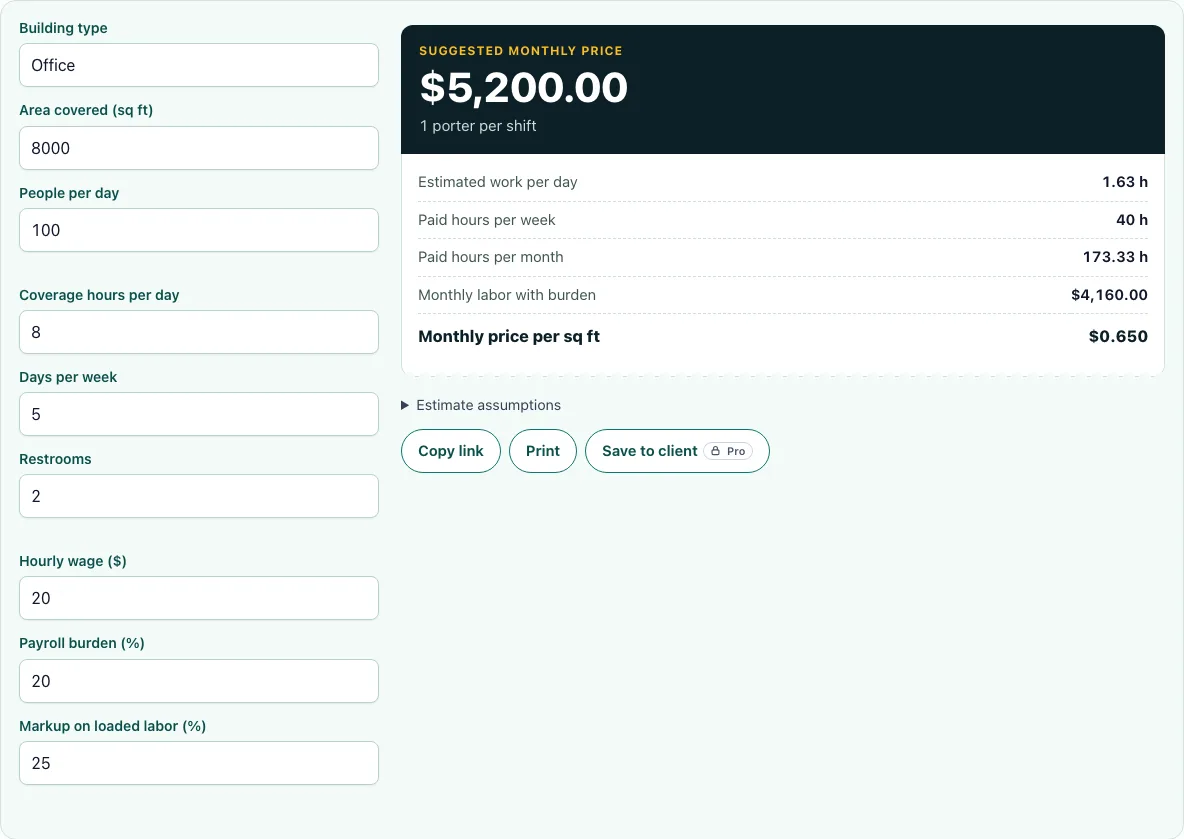
Worked example. An 8,000 sq ft office, 100 people per day, 2 restrooms, 8 coverage hours, 5 days per week, a $20 per hour wage, a 20% burden and a 25% markup:
- Area: 8,000 ÷ 2,000 = 4 cleaner-hours × 0.25 = 1.0 h.
- People: 100 ÷ 800 = 0.125 h.
- Restrooms: 2 × 0.25 = 0.5 h.
- Workload: 1.0 + 0.125 + 0.5 = 1.625 h per day.
- Porters: 1.625 ÷ 8 = 0.2, rounded up to 1 porter.
- Weekly paid hours: 1 × 8 × 5 = 40 h; monthly: 40 × 52 ÷ 12 = 173.33 h.
- Loaded labor: 173.33 × $20 × 1.20 = $4,160.00 per month.
- Monthly price: $4,160.00 × 1.25 = $5,200.00, or $0.65 per sq ft per month.
Larger example. A 200,000 sq ft office tower with 2,000 people, 20 restrooms and the same schedule has 32.5 h of daily workload: 25 h from the area, 2.5 h from people and 5 h from restrooms. That needs 5 porters, 200 paid hours per week and a monthly price of $26,000.00, which is $0.13 per sq ft per month.
What is not included. Overtime, relief and break coverage, supplies, equipment and holidays are not in the calculation. Add them through the markup or in your own quote.
The calculator is free and runs in your browser; nothing is uploaded. Pro users can save an estimate to a client’s notes.
Frequently asked questions
What is a day porter, and what does a day porter do?
A day porter is a cleaner stationed in a building during business hours to keep it clean while people use it. Typical duties are restrooms, lobbies, spills, trash, break rooms and restocking. Night janitorial crews do the full routine clean after hours.
How much should I charge for day porter services?
The calculator does not use market rates. It builds the price from your own hourly wage, payroll burden and markup, plus the porter hours the building needs. Add overtime, relief coverage, supplies, equipment and holidays through your markup or in your own quote.
How many porters does a building need?
Divide the daily workload hours by the coverage hours per day and round up to a whole person, with a minimum of one. Workload comes from area, people per day and restrooms. The 200,000 sq ft tower example needs five porters on an 8-hour schedule.
Is a day porter different from night janitorial service?
Yes. A day porter works in the building during business hours and handles upkeep as it happens. A night janitorial crew does the full routine clean after hours. Price each service separately; one does not replace the other.
Is price per square foot a useful number?
It is a quick sanity check, but it changes sharply with building size. A small building still pays for at least one porter for the whole coverage window, so the 8,000 sq ft office comes to $0.65 per sq ft per month while the 200,000 sq ft tower comes to $0.13.