Janitorial Bid Calculator
Fill in a bid sheet area by area to get cleaning hours and a monthly janitorial bid.
Recent
Your last 10 settings, saved only in this browser. Nothing is uploaded.
The janitorial bid calculator is a free tool that estimates a monthly price for janitorial work. You list each area of a building with its size and how often it gets cleaned, and the tool works out the cleaner hours needed and the price to charge. It runs in your browser, so there is no account or sign-up.
Use it to fill in a janitorial bid sheet, check your janitorial workloading, or test different janitorial pricing before you write a proposal. Every rate and cost is editable, so you can match the numbers to your own wages, expenses and crew speed. Each row is one area, so you can see which part of the building drives the hours. The result is a starting estimate, so check the production rates against your own work before you send a price to a client.
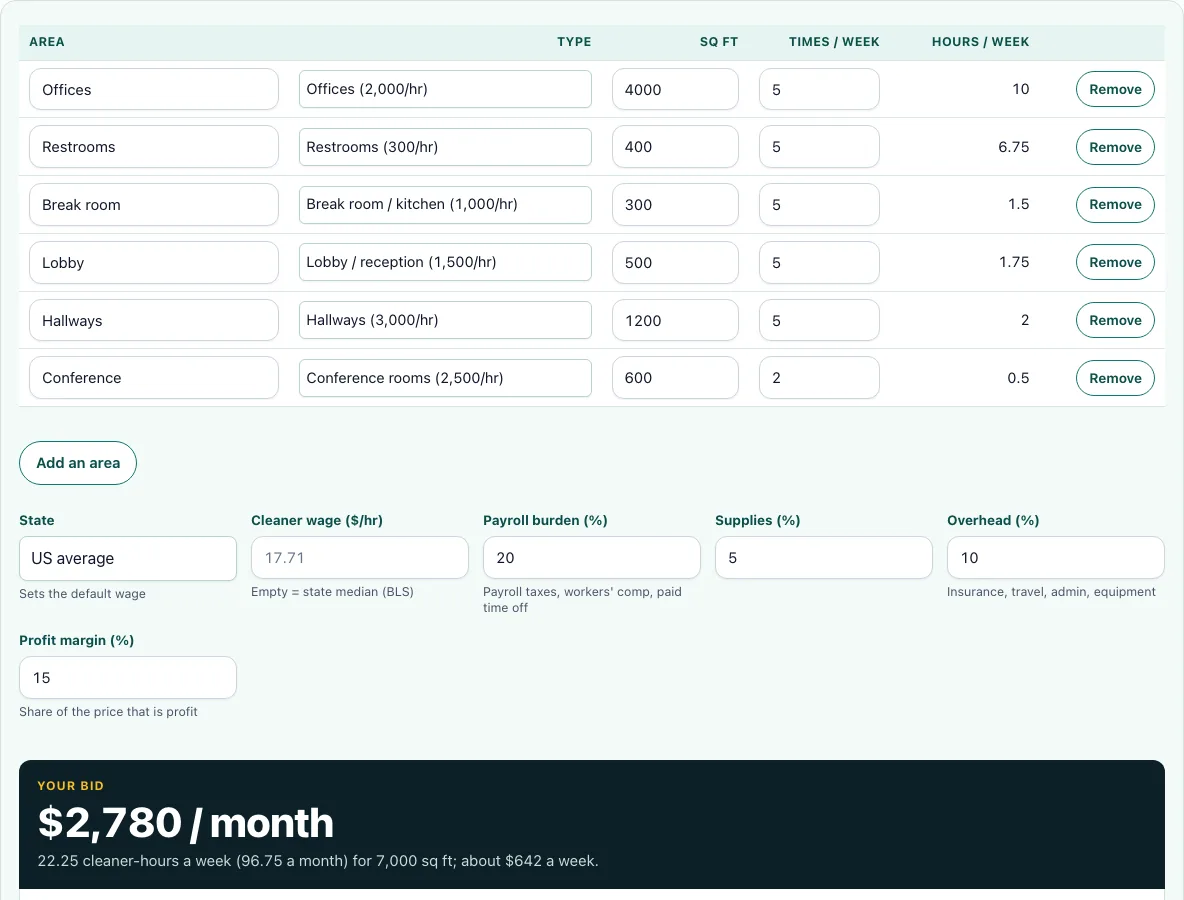
How to use the janitorial bid calculator
- In the first row of the bid sheet, type the area name, such as “Offices” or “Lobby.”
- Choose a Type from the list. Each type has a production rate in square feet per hour, such as Offices at 2,000 and Restrooms at 300.
- Enter the area’s Sq ft.
- Enter Times / week, the number of visits the area gets each week.
- Check Hours / week in that row to see the labor for that area.
- Click “Add an area” for each remaining area. Use Remove to delete any row you do not need.
- Enter your State, then your Cleaner wage. If you leave the wage empty, the tool uses the state median for janitors and cleaners (BLS, May 2025; US $17.71).
- Review Payroll burden, Supplies, Overhead and Profit margin. The starting points are 20%, 5%, 10% and 15%.
- Read the monthly bid in the box. Below it, check the per visit and per square foot per visit figures, the cleaner-hours per month and per year, and the receipt.
Work row by row, and check Hours / week after each entry. If one area shows far more hours than you expected, look at its Type and Times / week first.
Your settings are kept in the page address. Click “Copy link” to share the exact estimate or bookmark it. Click “Print” to print the result. On a phone, wide tables scroll sideways inside their box.
How do you calculate a janitorial bid?
Work out the cleaner hours the job needs, price those hours at a wage, then add payroll burden, supplies, overhead and profit. The bid is total cost divided by one minus the profit margin.
The steps are:
- Direct labor = hours × wage
- Payroll burden = labor × burden %
- Supplies and overhead = (labor + burden) × their percentages
- Total cost = labor + burden + supplies + overhead
- Bid = total cost ÷ (1 − profit margin)
Dividing by (1 − margin) matters. A 15% margin means 15% of the price is profit, so the cost must be 85% of the price. Adding 15% to the cost would leave you with less than 15% profit.
What is janitorial workloading?
Janitorial workloading is measuring how much cleaning time a building needs, so the price comes from labor and not guesswork. Each area becomes hours by dividing its square footage by a production rate, which is the square feet one cleaner covers in an hour, and then multiplying by the visits per week.
Weekly hours are the sum of (sq ft ÷ production rate × times per week) across all areas. Monthly hours are weekly hours × 52 ÷ 12, because a year has 52 weeks spread over 12 months.
How long does it take to clean a restroom?
A 400 sq ft restroom takes about 1.3 hours per visit at the tool’s starting rate of 300 sq ft per hour, since 400 ÷ 300 is 1.33. The real time depends on the fixtures, the supplies and the cleaner’s pace. Time your own first visit and replace the starting rate with the figure you measure.
How do I price areas cleaned on different days?
Enter each area’s own Times / week, then price the total weekly hours instead of a single daily rate. Each row’s hours are multiplied by its visits, and all rows are added together.
For example, 1,200 sq ft of hallways at 3,000 sq ft per hour is 0.4 hours per visit. At five visits a week, that is 2.0 hours. Conference rooms of 600 sq ft at 2,500 sq ft per hour take 0.24 hours per visit, or 0.48 hours at two visits a week. Both areas count toward the same weekly total, so the bid covers each day’s work.
What should a janitorial bid include?
A janitorial bid should cover every area in scope, the cleaner hours for each area, and every cost that turns those hours into a price. In this tool, that means labor, payroll burden, supplies, overhead and profit, shown as a monthly figure with its hours.
Payroll burden is easy to leave out. It covers 7.65% for Social Security and Medicare, plus unemployment taxes and workers’ compensation. Those costs are paid on top of wages.
Frequently asked questions
Are the production rates right for my building?
The rates are starting points, not guarantees. Time a first visit to each area, then replace the rate with your own measured speed.
What does the default sheet come to?
The default sheet has offices at 4,000 sq ft, restrooms at 400, break room at 300, lobby at 500 and hallways at 1,200, all cleaned five times a week, plus conference rooms at 600 sq ft twice a week. It comes to 22.3 cleaner-hours a week, or 96.7 a month, and a bid of $2,780 a month at the US wage.
What does the Type list change?
Each Type sets the production rate in square feet per hour: Offices 2,000, Restrooms 300, Break room / kitchen 1,000, Lobby / reception 1,500, Hallways 3,000, Conference rooms 2,500, Warehouse floor 5,000 and Stairwells 800. Pick the type that matches the work in the area. A restroom takes far more time per square foot than a hallway, so the type changes the hours a lot.
Which figure should I quote?
The sheet shows the monthly bid in the box, along with the bid per visit, the bid per square foot per visit, the cleaner-hours per month and per year, and the receipt. Quote the figure that matches how the contract is billed. If the client pays monthly, use the monthly box.
Do I need an account to use the janitorial bid calculator?
No. The tool is free, needs no account or sign-up, and nothing you type is uploaded. A note on the page says saving estimates and branded quotes are coming soon.
Why does the bid come out higher than the wage cost alone?
The bid includes payroll burden, supplies, overhead and profit, all of which are added on top of direct labor. Profit is calculated from the margin in a way that keeps it at the percentage you set.
Related tools
- Cleaning bid calculator: Use it when you are pricing a general cleaning job and do not need the janitorial area types.
- Commercial cleaning cost calculator: Use it to estimate what a commercial cleaning contract will cost to run before you set a price.
- Commercial cleaning rates per square foot: Use it to compare your price against rates quoted per square foot.
- Office cleaning checklist: Use it to list the tasks each office area needs, so none are missed in your bid.
- Cleaning proposal template: Use it to turn your bid into a written proposal for a client.
- Cleaning contract template: Use it to set out the terms once a client accepts your proposal.